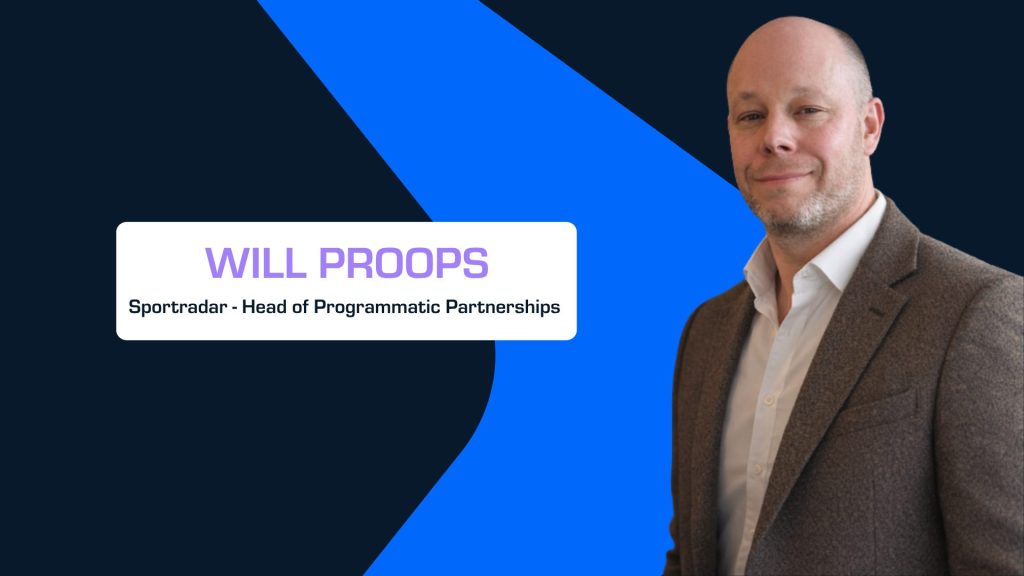
A Conversation with Will Proops, Head of Programmatic Partnerships at Sportradar
Welcome to Industry Perspectives, the content series from Onetag where we highlight leaders shaping the future of programmatic and ad tech. Each edition features real voices from the field, sharing practical insights and perspectives on where the ecosystem is heading.
In this edition, we’re pleased to speak with Will Proops, Head of Programmatic Partnerships at Sportradar. Drawing on decades spent across nearly every seat in the ecosystem, Will offers a clear-eyed take on what actually moves the needle in programmatic, pushing past inflated promises and scale claims toward real proof points, supply quality, and partnerships built on honesty rather than hype.
Q: What energizes you most in your current role, and what keeps you motivated in such a dynamic industry?
What energises me is solving problems at scale.
I’ve spent more than 15 years in programmatic and over 25 years in advertising across being a media owner, a publisher, an agency, an exchange, a data provider, and an advertiser; which means I’ve successfully survived ad networks, ad exchanges, RTB, the year of mobile at least 6 times, being mobile-first, header bidding, blockchain, NFTs, the threat of cookie apocalypse at least 3 times, and at least seven “revolutionary” identity solutions.
I’ve learned that while the flow of acronyms never seems to stop, the objective doesn’t. It’s simple: help brands reach the right people, in the right environment, and deliver measurable business outcomes.
At Sportradar, I get to work at the intersection of media, technology, data and sport. During any one day I’m discussing buying strategy with an advertiser, evaluating a new supply partnership for any number of formats and platforms, highlighting our real time sports data to buyers and marketplaces, explaining our unique data assets like Sports Moments and FAN ID, and discussing how we can help our DSP make more effective buying decisions for than 200 clients globally. All this typically before lunch.
Every day is a combination of strategy, partnerships, innovation and occasionally trying to work out what someone meant in a slide deck.
Advertising isn’t curing diseases or landing people on Mars, but helping brands connect with consumers effectively is still an interesting challenge, and unlike rocket science, people will happily argue about attribution models or supply paths over a beer.
Q: What are the biggest challenges and opportunities you see today in digital advertising, and how are you tackling them?
The biggest challenge is that everyone wants simplicity while simultaneously creating more complexity.
Advertisers now have CTV, retail media, DOOH, commerce media, social, AI, gaming, digital audio, influencers, attention metrics, clean rooms, identity graphs and about 400 different dashboards that all claim to be indispensable. We now have more signals, more data, and better technology than ever before to deliver relevant advertising if we use them intelligently.
The problem is that marketing budgets haven’t become any less accountable.
The opportunity is that most of this technology is actually useful.
The real challenge is determining which 10% matters and which 90% exists primarily to justify someone’s Series B funding round.
At Sportradar, we’re focused on simplifying that complexity. By combining premium sports audiences, live sports moments, automated ads with real–time data, quality supply, and DSP activation, we’re helping advertisers focus on results rather than trying to decipher the latest 80-page industry trend report.
At Sportradar we’re focused on outcomes, not buzzwords. That’s become surprisingly differentiating over the past 5 years. Because no marketer has ever said, “I wish my media strategy was more complicated.”
Q: Which media or tech trend is getting too much attention — and which one is getting too little?
Too much attention: AI as a silver bullet.
AI is undoubtedly transformative, but some conversations make it sound as though it should suddenly replace strategy, creativity, and human judgment. You’d think AI has already solved advertising and we’re all just waiting for the invoices. Parts of the industry talk about it as if we’ve reached the point where strategy, creativity and experience are now optional.
I’ve been in the world of programmatic long enough to remember when every PowerPoint said “Big Data” on every slide. AI risks becoming this generation’s version of that.
The most valuable applications of AI are often the least glamorous: workflow automation, optimisation, forecasting, audience modelling, and helping teams make better decisions faster.
Too little attention: Supply Quality.
Everyone talks about targeting and volumes. Far fewer people talk about where ads are appearing and whether those environments are actually adding value.
As signal loss increases and privacy expectations evolve, trusted supply, quality content and strong first-party data relationships become even more important.
It’s not the most glamorous topic, which is probably why it doesn’t get enough conference panels. Yet supply quality has more impact on campaign performance than many of the shiny objects getting all the headlines.
It’s the advertising equivalent of vegetables. Not exciting, but probably good for you.
Q: How do you navigate the noise in ad tech and make smart decisions about partners and platforms?
I’ve developed a fairly simple test after many years in the industry.
If a company can’t explain its value proposition in plain English within two minutes, it’s probably not solving a problem; it’s describing a feature.
I look at three things:
- Does it solve a real problem for me?
- Can it scale?
- Can it prove incremental value?
The third point is where many solutions and offerings struggle.
Ad tech occasionally suffers from what I call “PowerPoint attribution” – everything looks amazing until someone asks for evidence.
The best partners are transparent about what works, what doesn’t, and where they create measurable value. Trust is built far faster through honesty than through exaggerated claims.
It’s amazing how refreshing simplicity becomes in ad tech.
Q: What does “value” mean to you in today’s programmatic supply chain?
Value means reducing waste and increasing outcomes for every participant without adding unnecessary complexity.
For advertisers, it’s performance, efficiency, and transparency.
For publishers, it’s sustainable monetisation and fair value exchange.
For technology providers, it’s having a clearly defined role that improves the process rather than simply existing within it.
The industry has spent years optimising for volume. Increasingly, we’re optimising for quality.
The future supply chain will likely be shorter, more transparent, and more accountable. Every participant will need to clearly demonstrate why they deserve their place in that chain. Simply being “in the middle” is no longer a business model. We should be demanding accountability.
For me, every participant needs to answer a simple question: “What improves if you’re involved?”
If the answer isn’t obvious, that’s probably the answer.
Q: What’s one thing you wish ad tech better understood from the DSP’s point of view?
Scale is no longer a differentiator. “We have billions of impressions available” stopped being a compelling pitch somewhere around 2018. If I had a $ for every pitch that contained this….
Everybody has scale. The internet is actually quite large. The industry has become exceptionally good at creating abundance. What advertisers increasingly need is differentiation.
We evaluate opportunities through the lens of performance, quality, operational simplicity, and client impact.
The best partners don’t just bring scale. They bring signal, insight, support, or access that advertisers genuinely can’t get elsewhere.
In a world of abundant supply, uniqueness and differentiation matters.
And ideally differentiation that doesn’t require a 90-minute onboarding call to understand.
Q: If you look back, what’s the most unusual or unexpected role that shaped how you lead today?
Hands down, co-founding a business.
Nothing prepares you for leadership like discovering you’re simultaneously the CEO, salesperson, strategist, customer support representative and occasionally the IT department.
It teaches you that titles matter a lot less than execution. It also teaches you that every business problem eventually becomes your business problem.
Which is a useful lesson for leadership and a terrible lesson for sleep.
You learn that leadership isn’t about having all the answers. It’s about creating clarity when others don’t have the answers either.
Q: Looking across your experience as both a senior leader and a co-founder, what moments or lessons most changed how you lead today?
Earlier in my career, I thought leadership meant having all the answers.
I’ve now learnt that strong leaders ask better questions. Good leadership is less about predicting the future and more about helping people navigate uncertainty. And in turn that people remember how leaders behave during uncertainty far more than they remember quarterly results. Technology changes constantly. Human behaviour doesn’t.
I’ve learned that while technology evolves rapidly, leadership fundamentals remain remarkably consistent. Build trust, and as Ted Lasso said “be curious”, encourage debate and focus on outcomes rather than hype.
The trends will change.
The PowerPoint decks will definitely change.
The fundamentals usually don’t.
Q: If your workday had a soundtrack, what would be on repeat right now?
“Running Up That Hill” by Kate Bush — trying to explain programmatic advertising to people who think it’s just buying banners.
Q: If you weren’t in this industry, what do you think you’d be doing?
A sports commentator. Talking confidently about outcomes after they’ve already happened sounds considerably easier than forecasting them beforehand.
Q: Coffee or tea?
Yorkshire tea, strong, no sugar.